Showing posts with label Great Dixter. Show all posts

Saturday, June 07, 2014

VIDEO: Sketching with coloured pencils #1

..and finally - we have a video of me sketching! Watch it here - or for the big HD version click the link and go to YouTube where you can view it on my YouTube Channel. Below you can also view some photographs from my day out at Great Dixter yesterday.

Making a video of me sketching!


I can't remember how many years it's been since I started thinking about making a video of me sketching. Last year I did get as far as making a slideshow of a step by step - see © Katherine Tyrrell Sketching the Long Border, Great Dixter (July 2013)

I've long said I'm going to produce a video of me sketching - and years have gone by during which time I have bought tripods etc and never ever done anything about it. We then come to the advent of the mini iPad and I've again begun to think about videos of sketching.  Yesterday quite spontaneously I finally did it!

...and finally - this is it!


This comes with about 15 seconds of thought and preparation and starts with me taking the mini iPad back into my own hands from "he who must not be bored while I sketch" - who was supposed to be filming me - just as he has yet another hay fever attack.

That's when I discovered I could actually hold the iPad Mini and sketch by looking at the sketchbook through my iPad!  For those of you with iPad Minis why don't you try it?

You might be interested in how I hold a pencil....... however my pudgy hands distress me - they come courtesy of both age and disability!

Other than that take a look at my first go at iPad videos of me sketching.  Like I said - this is spontaneous - and you get the usual features associated with sketching (something falls over , the sketchbook goes skew whiff etc).


More about my day out and photos of the sketching set-up


Who would have thought that writing a book about drawing and sketching would have led to a drought in terms of plein air sketching - and blogging about my sketching? My visual capacity in my brain has been completed filled with selecting and gathering in images (and copyright forms), rescanning and photographing over 100 images of my own plus creating lots of diagrams to explain points.

It was absolutely idyllic yesterday to sit in a very English Garden and enjoy the humming of the mower, the singing of the birds and the shade of a barn on a very hot day in East Sussex - and to also enjoy getting back into my plein air sketching!

The view


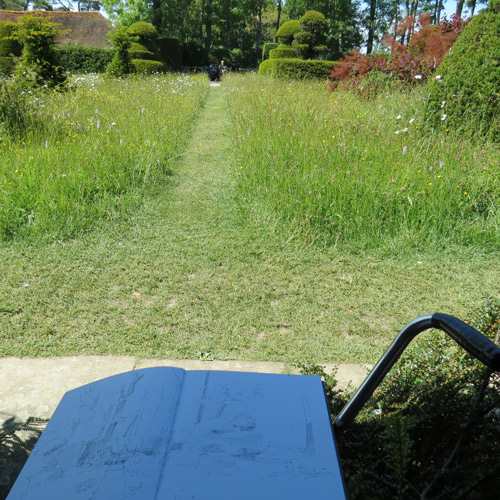
Here's the view of The Topiary Lawn at Great Dixter with its edge/fence of ash trees that I was sketching.

The trees reminded me of both Sisley (long slim tree trunks) Hockney (tree surgery!). I liked the people on the big bench as it added life into the garden - and of course show me yew topiary and I'm itching to get my sketchbook out - all those nice big shapes!


This shows you how far away I was actually sat - in the old cow shed which was lovely and cool (it was a very hot day yesterday!) - looking out across the wild flower meadow which surrounds the yew topiary! Listening to the grass paths being mown.

The set-up and kit


This is where I was sat

My sketching kit and where I was sat in the old cow shed
This is the pen and ink sketch - after a bit of judicious work in Photoshop - the photograph shows the white paper as actually being blue - as per the one above.
But you can retrieve blue sketches - see my blog posts about how to do colour corrections on Making A Mark


The pen and ink sketch I usually do some hatching to indicate shadows and form
particularly when it's a time of day when the sun is moving quite fast.

This is where I'd got to prior to the video. One of the aims of the day was a test of my new Stillman and Birn Zeta sketchbook with extra heavy weight paper in Natural White (kindly supplied for review by Stillman and Birn via Jacksons Art Materials). Plus a new pen - a Sakura Micron Pigment Ink - size 01 with archival ink. More about this on Making A Mark Reviews later.

The sketching kit in use - before I started the video
Stillman and Birn Zeta Sketchbook - the double page spread is 30cm x 42cm
the pen is a Sakura Micron 01 and
the coloured pencils are usual ecelectic assortment by Caran d'Ache Pablo, Lyra Rembrandt,
Faber Castell Polychromos and there's even an old Karisma Lime Green in there!
More of my sketches at Great Dixter can be found by clicking this link.

The wildflower meadows at Great Dixter


This is what the wildflower meadows are looking like at Great Dixter at the moment. I have never ever seen so many orchids in one place! The meadows are part of The Weald Meadows Initiative developed by the Wild Meadows Partnership. Great Dixter is supporting the High Weald Landscape Trust's campaign to double the number of wildflower rich grasslands in the High Weald by 2015. Now is the time to see them!

One of the Wild Flower Meadows at Great Dixter

There are thousands of common Spotted Orchids 
in the Great Dixter Wildflower Meadows.

Visit Great Dixter


If you want to visit Great Dixter, I suggest you take a look at a few facts

Wednesday, July 17, 2013

A step by step sketch of the Long Border at Great Dixter

We visited the wonderful garden at Great Dixter yesterday.  The garden was full of tourists from Europe who'd come specially to see the garden - which was looking very full of flowers and plants and absolutely splendid as usual.

My sketch of the Long Border at Great Dixter
pen and sepia ink and coloured pencils in Large Moleskine Sketchbook
copyright Katherine Tyrrell
Below are step by step photos of how I got to the above (unfinished) sketch which I did while sat on the seat at the end of the Long Border.  I thought people who've not seen one of my step by steps before might find it interesting.

Media used are as follows.  Links go to either my website Pastels and Pencils - Art Materials or to the Sketching Toolkit module within my website Travel Sketching: How to sketch the places you see

Here's the sketches one by one

Sketch #1:  Mapping a pencil outline and guides

This was a complicated sketch, both in terms of subject matter, zones, and perspective.  So, as I knew I was going to be drawing with pen and ink I decided to give myself a little bit of help.

I first took a photo.  That's something I very often do to work out what to make the four lines around the edge of the sketch - what to leave in and what to leave out.

I looked at my photo and used it to map out some very rough guidelines quickly in pencil.  This took me no more than two minutes.  I was mentally looking for halves, quarters and thirds relative to the picture format as I found my guidelines.

I added in a bit of shading afterwards just to remind myself where the darks are - it's help to locate places within the picture when doing a complicated sketch.

Pencil guidelines and a bit of pencil hatching re darker tones
mechanical pencil in Large Moleskine Sketchbook
copyright Katherine Tyrrell

2. Starting to draw with pen and sepia ink

This photo was taken after I started to draw in the lines I wanted for my sketch. I highlight shapes - both large and small, squiggley edges of plants, edges of tonal areas, important lines and edges which guide in and around the sketch eg edge of the path, roofline.

I also started to add in hints of the colours as I find this helps me with the drawing.  Saves time trying to work out which bit is which!

Starting the pen and ink drawing for the sketch
pen and sepia ink in Large Moleskine Sketchbook
copyright Katherine Tyrrell

3. Starting to add Coloured Pencil

Initial layers of coloured pencil are focused on the things I need to resolve the distances involved.  I find if I get the foreground, middle ground and background issues resolved I then find it easier to find my way around a complicated sketch.

At this stage there are lots of "notes to me" in this sketch - of things that need to further developed and finished later.  For example, I'm using ink to hatch in the beginnings of what will become darker areas.  Plus I'm locating the colours of specific flowers in the border.

Starting to add coloured pencils
pen and sepia ink and coloured pencils in Large Moleskine Sketchbook
copyright Katherine Tyrrell

4. More Coloured Pencil

One of the main things I do when using coloured pencils is to mix colours and tones on the page.  I don't want the 2D flatness that you get when you use just one colour for an area of colour.

For example, there's about six colours in that roof and about four shades of green in the strip of grass alongside the path.

I'm also constantly tying in colours laid down in one place to colours used elswhere - which adds unity to the development of the sketch

Starting to think about darker tones and variation within 'one colour' areas
pen and sepia ink and coloured pencils in Large Moleskine Sketchbook
copyright Katherine Tyrrell

5. Where I've got to


The sketch as it stands at the moment (see top) is where I got before "he who must not be bored while I sketch" decided it was time for tea!

It needs finishing.  Everything is a little bit too light.  The light areas need more darks so they'll start to pop. The main thing is that I needed more greens to complete the trees and the hedges.

I'll post the proper sketch when I've finished it.

UPDATE:  Here's the movie of a slideshow of the sketches!

This is how it was made - Sketching slideshow - iPhoto to slideshow to Quicktime Movie


More sketches of Great Dixter


Below there are more sketches of Great Dixter - ordered chronologically.  There's even another sketch of the Long Border!

More about Great Dixter and gardens


These are some more links which you may find interesting if you like gardens

Tuesday, November 15, 2011

The Bird Topiary at Great Dixter

The Bird Topiary at Great Dixter
pen and sepia ink and coloured pencils, 11" x 16"
copyright Katherine Tyrrell

One of our Indian Summer Jaunts at the end of September was down to Great Dixter in East Sussex to see the garden in late summer.

We let the satnav do the navigation and ended up having a delightful journey across Kent and East Sussex which I'd never have done if trying to read a map (The other half isn't wonderful at reading maps so we've always taken main road routes hiterto).

We got there at lunchtime and sat and had our sandwiches while sat in the Sunk Garden next to the Barns.  Then took a leisurely trip round the garden to see what had changed before I started the sketch at the top of the post.

The original plan had been to sketch the topiary birds in my Moleskine A4 sketchbook to see how they worked and then sketch them again for "A Postcard from my Walk".

The sun had other ideas!

This was on the 28th September and it was very hot in East Sussex with a clear summer blue sky with absolutely no clouds.  Even the sunlover aka he who must not be bored while I sketch couldn't cope with sitting in the sun for longer than 20 minutes as it was just too hot!  (The BBC ran a slideshow the next day In pictures: Autumn Heatwave of what people had been getting up the previous day during the Indian Summer and the Guardian was writing about how retailers were having to switch back to summer mode)

So my sketch for the postcard had to be done at home based on my sketch in the garden - which in turn also had to be finished off at home re the dark tones at home as it takes forever to get the right dark green.  The trick is to do a bit in the garden and then know how much more needs to be the same colour to complete the sketch!

The Topiary Birds at Great Dixter

Here's the link to the post about the sketch on A Postcard from my WalkGreat Dixter, Sussex

The garden is now closed but opens again in April next year.  It's one of my favourite gardens and is definitely worth a visit if you are every in the area.

Links:

Monday, March 30, 2009

Some of my favourite gardens

As many of you will already know, I love sketching in gardens. I've written about them previously in Gardens and Botanical Art over on Making a Mark. However I've been making a lot of websites about gardens recently so that I can share them with people - and I thought they might be of interest or use to fellow bloggers who enjoy sketching in gardens

The gardens I've been making websites fall into one of two categories. They are:
  • either some of my favourite gardens
  • or important gardens which deserve highlighting - and are going on my 'to visit' list.
If you fancy travelling with your sketchbook to some of my favourite gardens (or just pay a virtual visit) why not check out the following websites - you'll find all the logistics details as well as what commentary on what they have to offer. You can easily bookmark them or share them with others using the functions in the right hand column of each site. Now I've got my laptop up and running again, I'm planning to include some slideshows of photos I've taken at some of the gardens

You'll also find some of my sketches providing some visual interest on a number of the sites!

Some of my favourite gardens

The Royal Botanic Gardens at Kew
Over a million people visit the Royal Botanic Gardens at Kew each year. The 300 acres of gardens and botanical collections are a UNESCO World Heritage Site, which means they rank alongside Stonehenge, the Pyramids, and the Taj Mahal!

RHS Wisley - a Great Garden
Wisley Garden, in Surrey, is the flagship garden of the Royal Horticultural Society and is probably the most visited garden in the UK after Kew Gardens.

Munstead Wood - a great garden
For garden designers, Munstead Wood in Surrey is one of the most famous gardens in England. It was the home of Gertrude Jekyll who is renowned as a plantswoman. She created ways of planting which were very innovative in their day - and the garden at Munstead Wood was one of the places where she tried out her ideas.

Sissinghurst Castle Garden - a great garden
Sissinghurst Castle Garden in Kent is probably the most famous 20th century garden in the UK and is an English Heritage Historic Garden Grade I. It's also recently been the subject of a BBC Documentary series. It's one of my favourite gardens for the sheer variety and yet domestic scale.

Great Dixter - a great garden
Great Dixter in East Sussex was created by Christopher Lloyd and is a garden which is extremely popular with plantsman gardeners - those who particularly like plants and flowers. It's also quite close to Sissinghurst.

Tatton Park - a great garden
The gardens at Tatton Park in Cheshire are rated as being among the most impressive in England. Tatton Park has also been the the home of the RHS Flower Show since 1999. The 50 acre gardens are laid out in a traditional Edwardian fashion around the mansion home of the Edgerton family. Both are located within a 1,000 acre deer park. This is a garden I often used to visit as a child and that I now return to as an adult when visiting family.

Bodnant Garden - a great garden
Bodnant Garden in North Wales is one of the most beautiful gardens in the UK and is world-famous. It comprises lawns, terraced gardens and is noted for its botanical collections and wide range of plants. I used to visit when a child and memories of the laburnum arbor are still very fresh in my memory

Giverny - a great garden
Giverny is a very famous garden created and painted by Claude Monet. When I visited Giverny for the first time I was immediately struck by the fact that Monet did not only create art with oils.

My 'to visit' list

The Lost Gardens of Heligan - a great garden
These Cornish Gardens are now famous in the UK. They were left to grow wild for decades before a major restoration project was started in 1996 by Tim Smit. Although still part of an ongoing project, the garden now attracts a huge number of visitors

Malmaison - a great garden
The Château de Malmaison was the home of Napoléon's first wife - the Empress Joséphine and became the birthplace of the tea rose. The garden she developed included more than 250 varieties of roses and other exotic flowers from her native West Indies, and rare species from Australia. The catalogue of the garden became famous as one of the most exquisite publications of botanical art in the world.

In reality, you only need one bookmark if you want to keep track of what's going on - and that's Great Gardens of the World - which also includes some gardens recommended by other people

If you like any or all of the garden sites - or have visited any of the gardens - please leave can comment below or on any of the sites. You don't need to be a member of squidoo to comment.

Sunday, October 12, 2008

Travels with a sketchbook - in the South of England

Top L to R: Munstead Woods; Penshurst Place
Bottom L to R: Fields to the rear of Sissinghurst Castle Garden - in Spring and Autumn


This post lists all those posts which relate to places - and gardens in particular - in the South of England outside London.

Counties are listed alphabetically. The posts are then listed in the order they were published except where there are a group belonging to one place (eg Sissinghurst) in which case those are grouped together. The images all come from the posts listed.

This summary will be updated periodically with posts as they are added to the blog. It will also be listed in the right hand column of this blog.

Berkshire & Buckinghamshire


East Sussex


Great Dixter

Sheffield Park

Gloucestershire


Kent


Chartwell

Emmetts Garden

Great Comp

Sissinghurst Castle Garden

Knole House and Park

Penshurst Place

Groombridge Place

Surrey

Hampton Court Palace

RHS Wisley

Munstead Wood

West Sussex

Sunday, August 03, 2008

The gardens of England


I'm developing a series of information sites related to the English gardens I visit from time to time with my sketchbook. As regular readers will know I like to provide information about the places I visit so that others can find out more about it if they want to and also to visit - either on a virtual basis or in reality.

Consequently, I usually end each blog post with a set of links related to the place I visit. In future, what I'm hoping to have is one link to the garden website and one link to my information website for that garden.

I've started with two of my favourite gardens - Sissinghurst and Great Dixter.
Each site will all the relevant blog posts from Travels with a Sketchbook and some of the sketches in the sites I create.

At the moment I've got both sites off the ground but I need to develop them so if you;re interested, I'd suggest that you also check back at a later date to see how they're doing.
  • The main area of development are modules devoted to each 'room' within each garden. I've got some done but need to do more.
  • I'll also be adding in a note for artists - about what they're like for sketching and a plan of the places I've sat to sketch - which you will see on this blog first.
I'd be delighted to receive suggestions from readers about relevant content.

I know that a lot of my readers also like gardening so I hope you enjoy the pictures, the information and the gardening books - and the blog posts about the garden by gardening bloggers!

Monday, July 28, 2008

The Long Border at Great Dixter

"Not a lot of room for weeds"
The Long Border at Great Dixter

12" x 16", coloured pencils in sketchbook

copyright Katherine Tyrrell

One of the things I love best in gardens is a big long herbaceous border full to overflowing with blowsy perennials. Such borders came about as a nineteenth century response to over formal gardens and were then popularised by garden designers such as Gertrude Jekyll in the Arts and Craft Period of garden design (see Gardens in Art: Arts and Crafts Gardens #1.)

Jekyll's partner in many house and garden design projects was Sir Edwin Lutyens so it's hardly surprising to find that there's a long herbaceous border at Great Dixter as Lutyen worked in collboration with the owner in the design of some of the house and garden. Not surprisingly it's called The Long Border - and if you click the link you can see just how long it is relative to what is a large house.

Great Dixter - The Long Border
looking north west to the house

copyright Katherine Tyrrell

It's been my ambition to have a go at sketching it for a while - but to do so I had to first decide where was the best spot. Then once I'd decided that the Lutyens Bench at the top end of the path was probably the best place I then actually had make sure I could sit on it as it's ALWAYS got somebody sat on it! (This is a garden with very few seats.)

However last Friday a couple got up just as I arrived at the Long Border and I scurried up the path which you can see in the photo below right (who am I kidding - I nearly broke into a trot despite the dodgy feet!) and managed to sit down on it before anybody else had the same idea.

The Long Border, Great Dixter - looking south east to the Lutyens Bench
(High Garden to the left and meadow to the right)
copyright Katherine Tyrrell

The plein air sketch at the top is the result. The title for the sketch comes from the comments from an elderly couple who came and sat next to me. "Not a lot of room for weeds" was the wry comment of the elderly gentleman.

This sketch started off as massive shapes of hatched colour which I just kept refining and refining until the end result was the above sketch.

People ruminate about composition - but sitting on this seat there wasn't a lot of choice - except where to crop! However I was helped by the huge dark shape of the tree which really set off the bright colours of the pink phlox, yellow verbascum and coreopsis verticillata and red crocosmia 'lucifer'. I loved the way that there were lots of different natural forms which intermingled. I think I captured the sense of profusion - although I don't think I've done as well as I would have liked with the cardoons!

I confess I added some more colour when I got home and also added some more "drawing by battery eraser" which I find works so well for producing lighter values and cleaning up paler patches and splodges. It is also fabulous for making a mark - quite literally - in lots and lots of different ways to create the sense of the different shapes created by the planting.

One of the outstanding features of the Great Dixter garden at this time of year is the Verbascum - which apparently are self-seeding and which are everywhere! The particularly large one is called Verbascum Olympicum and was very much favoured by Christopher Lloyd and his head gardener Fergus Garrett.
The biennial V.olympicum (2m/7ft) .....makes a heavy candelbrum (we need to give each plant a stake) which braches generously near the top, making a powerful head of yellow bloom. Some visitors think we have too much of this but Fergus and I think otherwise.
Christopher Lloyd - Christopher Lloyd's Gardening Year - July p141
Verbascum Olympicum in the Long Border, Great Dixter
copyright Katherine Tyrrell

Links:

Saturday, July 26, 2008

The Rother Valley from Great Dixter

The Rother Valley from Great Dixter
pencil and coloured pencils in Moleskine

copyright Katherine Tyrrell

...or more precisely, this is the view of the Rother Valley from the car park at Great Dixter at Northiam in East Sussex.

Great Dixter has very many people who visit this superb garden as it metamorphoses through the planting season. The garden was originally designed by Lutyens. It has become a labour intensive garden with heavy planting latterly maintained by Christopher Lloyd with the help of Head Gardener Fergus Garrett and his team and, since Christopher's death in 2006, by the Great Dixter Charitable Trust.

Friends of Great Dixter (and I'm one of them) know that that the choice of available refreshments is not great. Hence a lot of people tend to picnic in the car park before starting their visit or after coming out of the gardens! After all we have all come from miles around to visit the garden - it takes us a complete day!

I made this sketch while I eat lunch - being an inveterate "eater/sketcher". I've always really liked this view - it's even better when it has sheep in the field! I think I prefer the perspective from further over to the right and I'm going to make a more formal drawing out of that view one day.

The gardens were as fabulous as ever - much more rampant than in April when we last visited (see Great Dixter in the Spring). The gunnera down by the river and next to the pond is simply ENORMOUS!

Tomorrow I'm going to post my sketch of The Long Border and will also include:
  • a plan so you can see thr layout of the garden and where I've sat to do my sketches of the garden to date.
  • a small selection of the photos I took so you get a bit of a sense of the garden.
Links:

Wednesday, April 16, 2008

Great Dixter in the Spring

Reading in the Sunk Garden
11" x 8", pencil and coloured pencils in Daler Rowney sketchbook

copyright Katherine Tyrrell

We visited the late Christopher Lloyd's garden at Great Dixter yesterday. His book "Christopher Lloyd's Gardening Year has temporarily replaced the art books as my bedtime reading. I'd read all about April in the garden before we got there. I love the review of the book which is quoted on Amazon - it's absolutely spot on!
The Guardian - review by Ruth Gorb, December 3 1999
"Read CHRISTOPHER LLOYD'S GARDENING YEAR and you are in the company of a master gardener and friend. In this latest book he is, as ever, chatty, opinionated and inspirational. He disobeys all the rules and wages a long-standing battle against good taste: his combination of orange dahlias and vivid purple verbena may not be your cup of tea, but he describes it with such zest...To be in his company, even through the pages of a book, is a privilege and an education"
I'm now starting his book on Colour for Adventurous Gardeners. It contains this wonderful quote.
Given the right cirumstances, I believe that every colour can be successfuly used with any other and that is the message I hope to convey..............there is something called the Colour Wheel that I have never understood and that I shall not therefore attenpt to explore or explain. It is somehow intended to demonstrate which colours may successfully be put together and which may not, but the outcome makes no sense to me, so I shall go my own way without.
Christopher Lloyd - Colour for Adventurous Gardeners
We toured the garden and marvelled at the difference between the garden at this time of year compared to the total profusion later in the summer. I wrote about this in my post on Great Dixter at the end of August last year. Then I commented as follows
To tell the truth I found most of of the garden almost impossible to sketch for various reasons:
  • there are virtually no places to sit
  • the gardens are much more about a profusion and an experience than about views (the garden is compartmentalised and is simply stuffed with an amazing mixture of plants)
  • there is no place to put a collapsible stool or seat even if one were allowed to as paths are by and large narrow and the plants are spilling over them. There might be places where one could sit - but I found it very difficult to compose views with the camera and I'm guessing the problem would be even worse if trying to sketch compounded by the virtual absence of seats.
My current thoughts are that I should try and get more sketching done earlier in the year having now seen the difference in how the garden looks at different times of the year. It's certainly holds lots of attractions in terms of the leaves of various plants. Plus, if they don't object to me taking in a seat to the vegetable patches, they have great veggies! I've invested in an annual visitors ticket for two people which gives me free access to the gardens (only) at any time during the year when the gardens are open. It will pay for itself if we visit just once more this year!

Here are some of the photos I took yesterday.


After our tour round we sat in the Sunk Garden. 'He must not be bored while I sketch' read his book and I sketched - he makes a marvellous model! Maybe I should do a series of sketches or even a book - "Not being bored in various gardens"? ;) What do you think?

Last summer I was have included Great Dixter in a post about arts and crafts gardens on Making A Mark as part of my gardens project . However this got hammered by a major Blogger malfunction and hence never got posted. I might try and see if I can finish that today.

I've also updated my information site Gardens in Art - Resources for Artists and added in a module for posts from this blog about gardens I sketch. For more details about this site see below.

Links:
  • Great Dixter - house and gardens, High Park Close, Northiam, Rye, East Sussex, TN31 6PH
  • Gardens in Art - Resources for Artists
  • If you love looking at paintings of gardens or enjoy drawing or painting your own garden or gardens you visit then this site will interest you. It also looks at gardens as art and artwork in gardens. It shares links to information about:
    • looking at drawings and paintings of gardens
    • studying how different artists have responded to the motif of 'the garden' in order to understand more about different approaches to drawing and painting the garden
    • gardens which provide opportunities for drawing and painting
  • Books

Wednesday, August 29, 2007

Great Dixter

The Oast House, Great Dixter
8" x 10", pen and sepia ink and coloured pencil in Daler Rowney sketchbook
copyright Katherine Tyrrell

Yesterday, we visited the house and gardens at Great Dixter in East Sussex. I've heard of it often but have never made the longish journey down to its location in the village of Northiam, seven miles northwest of Rye.

To tell the truth I found most of of the garden almost impossible to sketch for various reasons:
  • there are virtually no places to sit
  • the gardens are much more about a profusion and an experience than about views (the garden is compartmentalised and is simply stuffed with an amazing mixture of plants)
  • there is no place to put a collapsible stool or seat even if one were allowed to as paths are by and large narrow and the plants are spilling over them. There might be places where one could sit - but I found it very difficult to compose views with the camera and I'm guessing the problem would be even worse if trying to sketch compounded by the virtual absence of seats.
Do take a look at the website for more details about the layout, design and conponents of the gardens. (When I've got the photos sorted I'll come back and add some into this post)

Finally I sat on the stone ledge seats in the Sunk Garden - next to the lily pond - and sketched the oast house roofs. We'd been having some rather threatening rain clouds and very fortunately we got that wonderful light you sometimes get when sun combines with rain clouds and hence had citric acid lemon trees against purpley blue skies right next to a rich terracotta tiled roof oft he oast house. I'm afraid I wasn't much interested in drawing much of the garden having seen those colours!

We then visited the house and admired the hammerbeam roof in the Great Hall, the solar and Christopher Lloyd's collection of gardening books.

What I found fascinating was the career of Nathanial Lloyd (Christo's father) who made the money to purchase and renovate the property and develop the garden by developing a very suucessful business supplying graphic art for advertising at the turn of the twentieth century. This effectively enabled him to retire - at which point he worked with Lutyens to develop the accommodation at Great Dixter and then became something of an expert on brickwork in English houses!

We came home via Rye. I don't know quite why but each time I eat there I have a dreadful meal. Ever the optimist? You'd think I'd have learned my lesson by now!

Links: